

Categories
- Case & News (50)
- Blog (612)
In markets for small-to-medium infrastructure and commercial ready-mix concrete, equipment transportation costs and installation timelines have long been two critical variables in initial project investment. Haomei Machinery’s containerized concrete batch plants address these pain points through systematic structural innovation: by integrating all core functional units into steel frames matching standard container dimensions, the concrete plant can be transported just like a standard shipping container. This offers customers a concrete production solution that enables rapid deployment and flexible relocation.
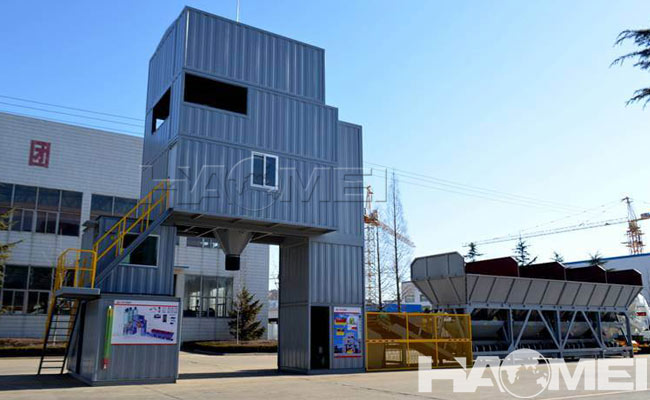
The defining design feature of the containerized concrete batch plant is that all functional modules adhere to standard container dimensions. Once disassembled, the entire concrete batching plant fits into standard 40HQ containers, eliminating the need for specialized bulk cargo transport. Taking the mainstream HZS60 concrete batching plant as an example, the entire unit ships in just three standard containers. This reduces cross-border logistics costs by 25–30% compared to traditional concrete plants shipped as loose components; furthermore, it eliminates the need to hoist oversized parts, more than doubling port loading and unloading efficiency.
Efficiency gains during installation are equally significant. Core components undergo pre-assembly and commissioning at the factory; on-site work is limited to connecting module flanges and electrical wiring, eliminating the need for extensive on-site welding. The total installation time is just 5–7 days—over 40% faster than traditional concrete batch plants—resulting in substantial savings on overseas labor costs. Once positioned, the equipment does not require a permanent poured-concrete foundation; it operates on a simple leveled, hardened concrete slab. This reduces civil engineering investment by over 60%, drastically lowering upfront fixed costs.
Many customers worry that containerized concrete batching plant equipment sacrifices performance for compactness; in reality, the core production specifications of Haomei’s containerized concrete plants are identical to those of stationary concrete plants with the same capacity. Mainstream models cover a production capacity range of 25–60 m3/h and come standard with the JS series twin-shaft forced concrete mixer. The HZS50 concrete batching plant is equipped with the JS1000 concrete mixer, featuring a nominal discharge capacity of 1000 L per batch and a standard mixing cycle of 60 seconds; it achieves a mortar density variation coefficient of ≤0.8% and can stably produce concrete across the full C10–C50 grade range.
The metering system utilizes a fully independent electronic weighing architecture, with dynamic aggregate metering errors ≤±2% and metering errors for cement, water, and admixtures ≤±1%, fully complying with EN 206 and ISO 19720 international standards. The plant maintains a stable continuous operational efficiency of 80%–85%, capable of an output of 320–400 cubic meters in an 8-hour day, fully meeting the daily supply needs of medium-sized municipal projects and county-level commercial concrete stations. The mixer’s liner plates and mixing blades are made of thickened high-manganese steel, offering a service life of ≥7,000 hours under normal operating conditions and ensuring long-term operational stability.
The containerized structure grants the equipment exceptional relocation capabilities. Upon project completion, the entire concrete batch plant can be quickly dismantled into container units and transported by road or sea to the next site, offering an equipment reuse rate over 60% higher than that of stationary concrete plants. This feature is perfectly suited for linear engineering scenarios involving multiple locations and short cycles—such as rural road network upgrades, distributed wind power foundations, and municipal emergency repairs—where a single unit can serve multiple sites, significantly amortizing equipment investment costs per project.
For export markets, the equipment supports customization for 380V/415V voltage systems and comes standard with CE certification; the operating interface supports multi-language switching, allowing general workers to operate the unit independently after just 3–5 days of training. An optional pulse-jet bag dust collection system is available, keeping dust emission concentrations at ≤30 mg/m³ to meet local environmental compliance requirements.
Based on years of overseas project experience, the advantages of containerized concrete plant lies in drastically lowering the time and financial barriers associated with setting up a plant. For small-to-medium-scale projects characterized by tight schedules, limited site space, and the need to relocate between multiple work locations, this standardized, modular equipment configuration is undoubtedly one of the most cost-effective choices available today.
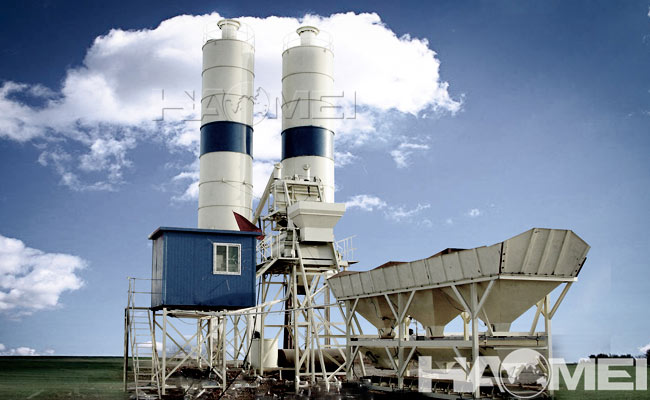 Concrete Batching Plant With Compact Structure
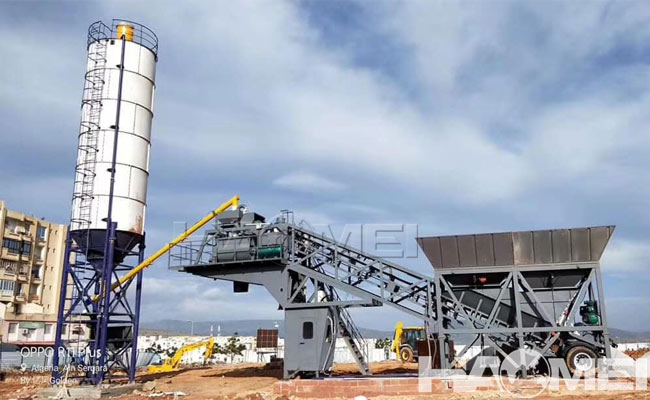 Small Mobile Batching Plant Price in 2026
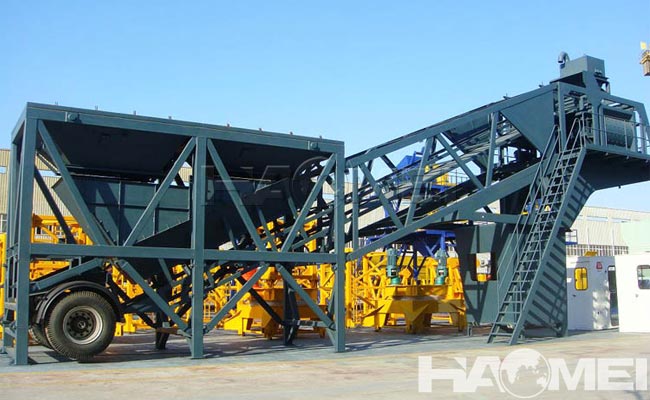 Portable Concrete Plant Price
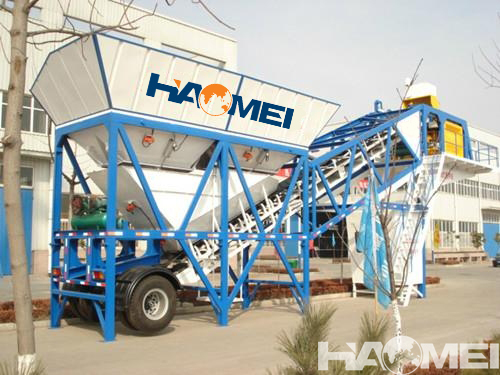 Mobile Compact Concrete Batching Plants