

Categories
- Case & News (50)
- Blog (622)
The stable operation of a concrete batching plant relies on standardized, periodic maintenance. A well-structured checklist can reduce equipment failure rates by over 40%, extend the service life of the entire plant by 3–5 years, and ensure consistent weighing accuracy and operational safety. Based on Haomei Machinery’s global project experience, maintenance inspections are categorized into four tiers, covering all core system components.
Daily pre-shift inspections are essential, requiring only 15 minutes to complete before operations begin.
For the mixing unit, focus on the gap between the mixing arms and the liner plates—the standard value is ≤5mm; if this threshold is exceeded, the positioning bolts must be adjusted. Verify that the gearbox oil level falls within the marked range and that there are no leaks at the shaft-end seals. Ensure the discharge gate opens and closes smoothly, and check that the sealing strips are intact and free from leakage.
For the weighing system, perform a zero-load calibration for each weigh hopper and confirm that sensor signals are stable. Ensure that dynamic weighing errors for aggregates remain ≤±2%, while errors for powders, water, and admixtures must be ≤±1%; recalibrate immediately if these thresholds are exceeded.
Regarding the conveying system, monitor the belt conveyor to ensure lateral deviation does not exceed 5% of the belt width, and verify that idlers are free from jamming or abnormal noise. Also, check that the inlets of screw conveyors are free from clogs or material buildup.
Finally, for safety and environmental compliance, test the responsiveness of emergency stop buttons and safety interlocks; ensure that the dust collection fans on the silos are functioning correctly and that there is no significant dust emission at the discharge point.
Weekly specialized inspections serve as in-depth preventive checks, requiring 1–2 hours of equipment downtime.
For drive components, monitor the operating temperature rise of the screw conveyor’s hanger bearings (must be ≤40°C) and inspect the oil in the main mixer’s gearbox to ensure it is free from emulsification or sediment.
For pneumatic and dust-collection systems, verify that the operating pressure remains stable between 0.6–0.8 MPa, with a pressure drop of ≤0.05 MPa over a 30-minute hold test; also, check the operating pressure differential of the pulse-jet dust collector filter bags (must be ≤1200 Pa)—clean or replace the bags if the limit is exceeded.
Regarding fasteners, retighten the main unit’s anchor bolts and all flange connection bolts to ensure there is no looseness or corrosion; likewise, tighten the bolts on the belt conveyor frame to eliminate any risk of structural instability.
Monthly comprehensive maintenance focuses on performance calibration, with a full-system verification completed during a half-day shutdown.
For wear-related components, measure the remaining thickness of mixing blades and liner plates—replacement is mandatory if wear exceeds one-third of the original thickness. Check belt tension, ensuring the sag under no-load conditions is maintained at 10–15 mm per meter of belt width to prevent slippage or excessive stretching.
For metering calibration, use standard test weights to perform static checks on all weighing units and correct any system deviations; also, verify the output accuracy of admixture pumps and the integrity of pipeline seals to eliminate leaks.
For electrical systems, tighten all wiring terminals and ensure motor insulation resistance is ≥0.5 MΩ; additionally, assess the data transmission stability of the central control system to guarantee that production records remain complete and traceable.
Quarterly and annual in-depth overhauls are designed to restore the overall performance of the equipment.
Regarding the lubrication system, replace the oil in the main mixer’s gearbox with specialized industrial gear oil—the first change should occur after 500 hours of operation, with subsequent changes required every 2,000 hours. Furthermore, replenish all bearing points with the appropriate type of grease.
Regarding structural safety, verify that the pressure safety valves on the powder silos are set to trigger at the correct pressure. Inspect the anti-corrosion coating on the steel structure to ensure a film thickness of ≥80μm, and touch up any damaged areas.
Additionally, check that the settlement deviation of the equipment foundation does not exceed 2mm/m to prevent structural deformation from compromising weighing accuracy.
Based on practical experience from overseas projects, approximately 60% of equipment failures stem from routine inspections that are merely perfunctory—specifically those concerning the zeroing of weighing systems and the checking of blade clearances. Haomei Machinery recommends that overseas projects stock up on original wear parts every 3 to 6 months to avoid downtime caused by long supply chains. We provides clients with comprehensive standardized maintenance manuals, factory-direct spare parts, and remote technical support. By strictly adhering to a tiered maintenance schedule, operators can limit annual downtime due to equipment failure to under 3 days, while reducing operation and maintenance costs per unit of output by 15%–20%.
 How Much Does It Cost to Build a Concrete Plant?
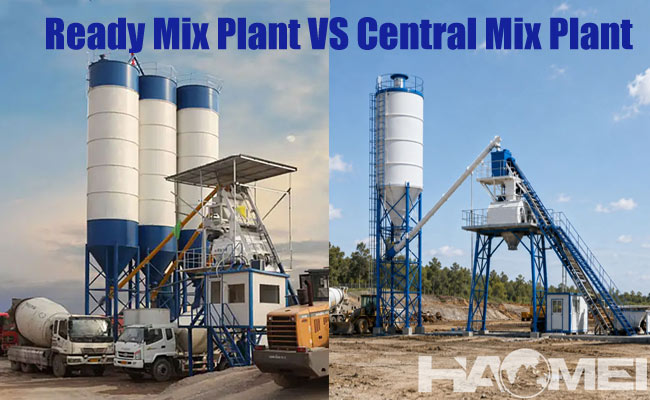 Ready Mix Plant VS Central Mix Plant
 Static VS Mobile Concrete Batch Plant
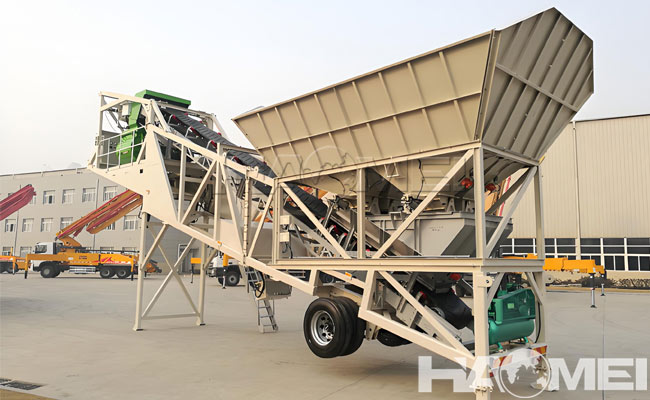 China Mobile Concrete Mixing Plant Manufacturer