

Categories
- Case & News (50)
- Blog (619)
Concrete batching plants are core production facilities for various construction projects, from municipal infrastructure and housing construction to transportation and water conservancy projects. The standardization of the production process directly determines the strength, slump, and homogeneity of the finished concrete, thus affecting the overall project quality. Most fluctuations in concrete quality within the industry are not solely caused by raw materials, but rather by issues such as mix proportion deviations and uneven mixing resulting from oversights in process control. Based on Haomei Machinery’s years of experience in equipment R&D and implementation serving the global construction industry, we have compiled key points for standardized operations throughout the entire process, providing professional reference for projects of different scales.
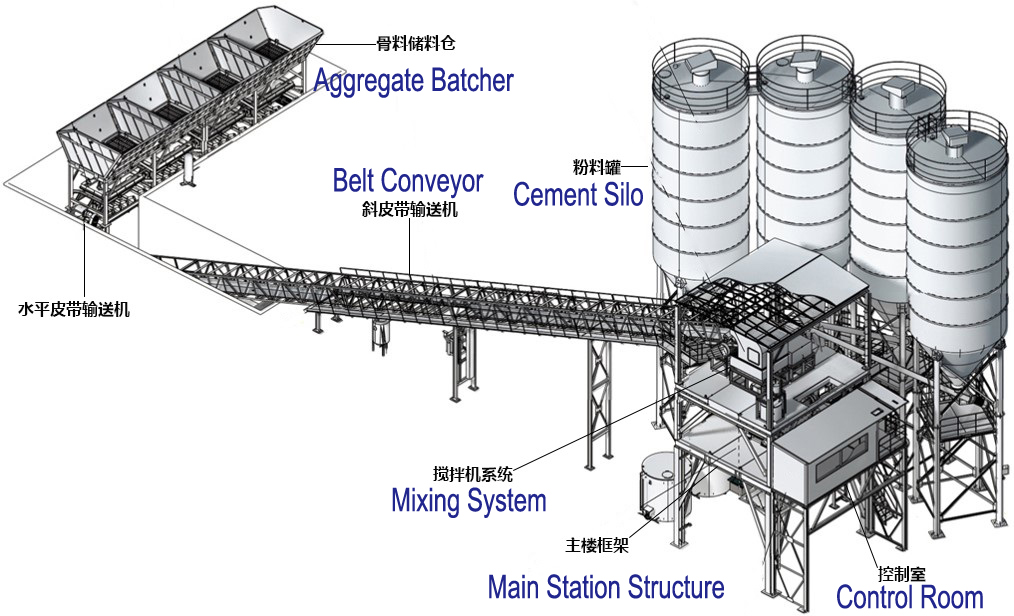
The initial stage of production involves the arrival and categorized storage of raw materials. Aggregates, cement powder, mineral admixtures, and additives must be stored separately, strictly prohibiting cross-contamination. Aggregates must be stored in enclosed silos to prevent significant fluctuations in moisture content due to rainwater erosion; powders are stored in sealed steel silos equipped with dust removal devices on the silo tops to prevent moisture absorption, clumping, and dust overflow. All raw materials must undergo random sampling inspections of core indicators upon arrival before being used. Haomei’s enclosed silo and bin design reduces raw material performance fluctuations from the storage end, simplifying subsequent mix adjustments.
Accurate batching and metering is a core control point in the process flow; mix proportion accuracy directly determines the concrete grade compliance rate. Before production, material mix proportion parameters must be set according to the design grade. Aggregates are dynamically weighed using belt conveyors, while powder, water, and admixtures are independently metered using high-precision electronic scales. The entire process is automated by the control system, requiring only manual monitoring and verification. Industry standards typically require metering errors to be controlled within ±2%, but Haomei’s high-precision sensors and dynamic calibration system can control errors within an even stricter range, mitigating quality risks caused by mix proportion deviations from the outset.
After metering, the material enters the closed conveying and feeding stage. Aggregates are transported to the main unit via a sealed belt conveyor, powder is conveyed in a closed system by a screw conveyor, and liquids and admixtures are pumped through dedicated pipelines, ensuring no exposed parts throughout the process. Compared to traditional open conveying systems, the enclosed structure effectively suppresses dust during production and prevents material spillage and contamination from external impurities, meeting the dual requirements of environmental protection and quality at construction sites.
Forced mixing is a crucial step in finished product formation. Currently, the mainstream technology in the construction industry is the twin-shaft forced mixing system. After the material enters the main unit, the twin shafts drive the staggered blades in opposite directions, creating a triple mixing effect of convection, shearing, and kneading. This ensures thorough and uniform mixing within a set time, eliminating dead zones. Haomei’s standard JS series and Sicoma MAO series twin-shaft main units are compatible with conventional concrete grades from C10 to C60, as well as some special concretes, meeting the high standards of construction engineering in terms of mixing efficiency and homogeneity.
After mixing, the finished concrete is unloaded into the mixer truck through the discharge port. The unloading process requires controlled flow rate to prevent material segregation. After each day’s production, the main unit, discharge port, and conveying pipelines must be cleaned promptly to prevent concrete from hardening and clumping. Wastewater and slag generated during cleaning can be treated through a supporting recycling system, with sand and gravel separated and reused, and wastewater recycled for cleaning, achieving low-consumption and green production.
A standardized process flow is the foundation of stable production, while suitable equipment is the carrier for implementing that process. Haomei concrete batching plants are optimized for all production scenarios in the construction industry, covering full-process control from raw materials to finished products, and providing stable performance to help various construction projects achieve efficient, compliant, and high-quality concrete production.
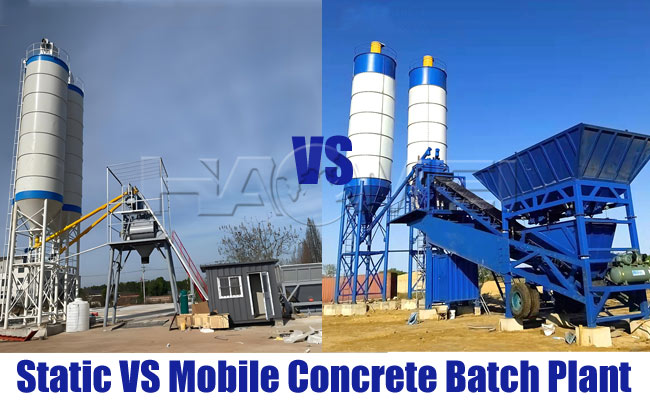 Static VS Mobile Concrete Batch Plant
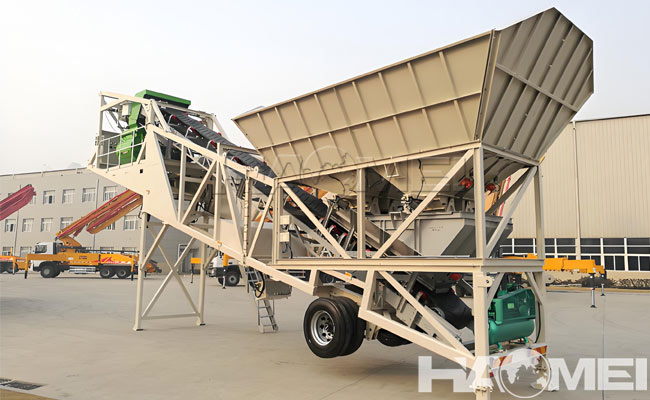 China Mobile Concrete Mixing Plant Manufacturer
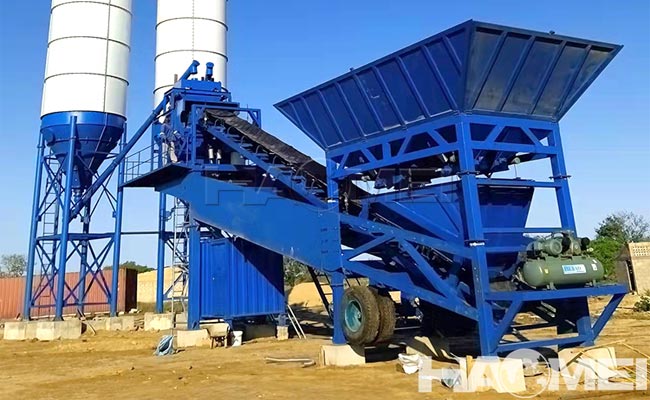 Mobile Wet-Mix Concrete Batching Plant
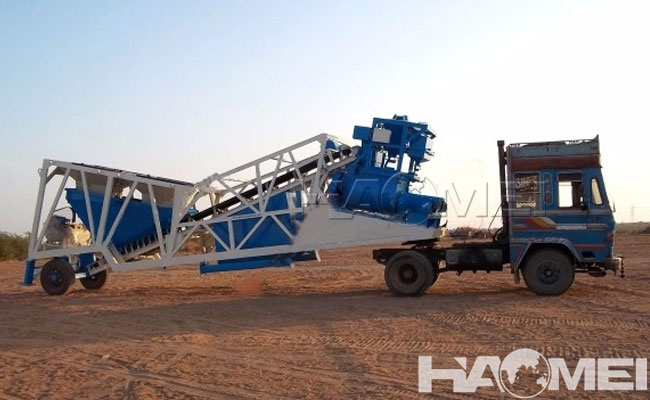 Easy Installation Mobile Concrete Batching Plant
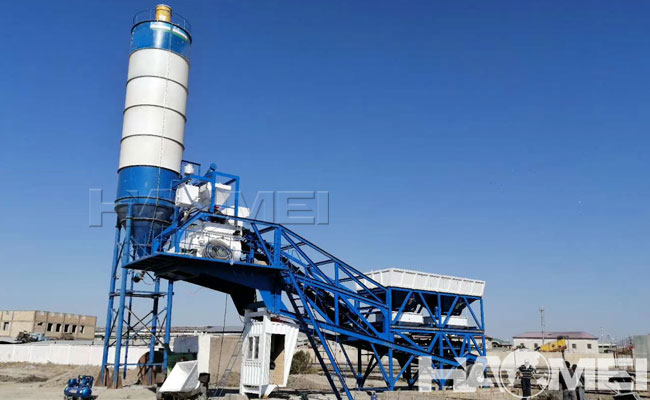 Fast Setup Mini Mobile Concrete Batching Plants