

Categories
- Case & News (50)
- Blog (604)
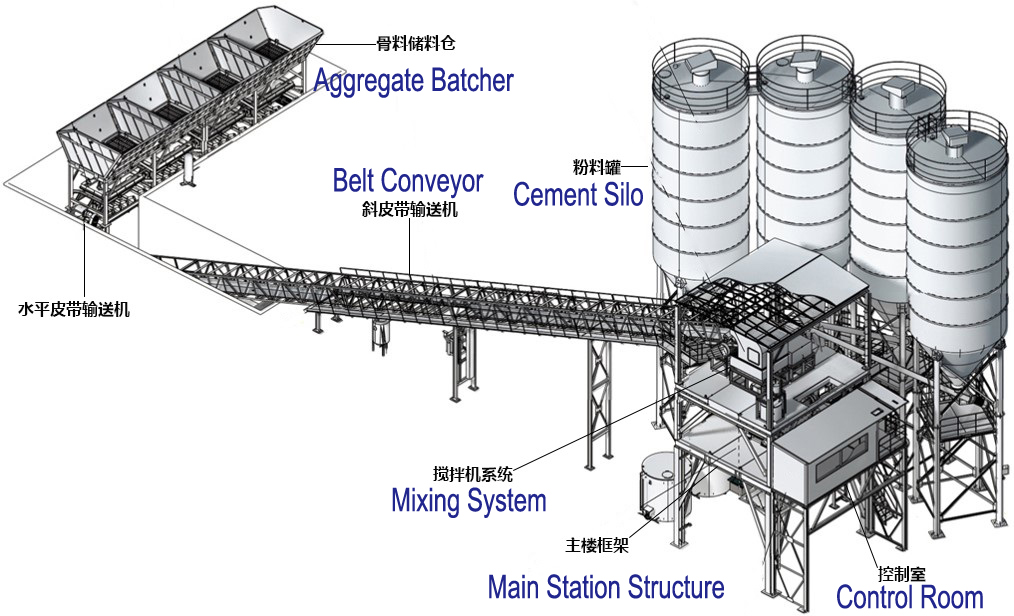
In equipment selection for medium-sized infrastructure projects and county-level commercial concrete batching plants overseas, the 90m3/h belt conveyor concrete batching plant has always been a highly cost-effective “all-rounder”—it avoids the capacity bottleneck of small plants and the investment pressure of large plants, finding a precise balance between capacity scale, operating efficiency, and implementation costs. As a classic high-volume model in Haomei Machinery’s export product line, the popularity of the HZS90 belt conveyor concrete batching plant is essentially due to its precise matching of the actual needs of most medium-sized overseas projects, rather than simply winning based on specifications.
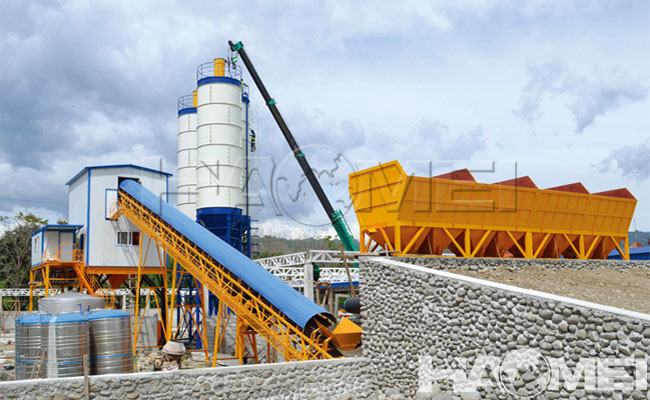
The first balance is the precise alignment of capacity scale with investment costs. For medium-sized municipal projects and county-level road projects with a construction period of 1-3 years, as well as small commercial concrete batching plants with an annual capacity of 100,000-120,000 cubic meters, the capacity of HZS50-HZS60 concrete batching plants is tight, while HZS120 concrete batching plants are prone to idle capacity. The HZS90 concrete batching plant comes standard with a JS1500 twin-shaft forced mixer, with a nominal discharge capacity of 1500L/pan, paired with dual 30kW drive motors. The standard mixing cycle is 60 seconds, and the theoretical capacity is 90m³/h. Under continuous operation, the actual stable capacity can reach 75-85m³/h, and a daily output of 600-700 cubic meters in 8 hours is sufficient to cover the daily supply needs of medium-sized projects. From an investment perspective, the initial purchase cost of the entire set of equipment is only 65%-70% of that of the HZS120 concrete batching plant with the same configuration, and the investment payback period is shortened by more than 20% compared to large stations, making it very friendly to small and medium-sized contractors and regional commercial concrete operators with limited budgets.
The second balance is the dual consideration of conveying efficiency and operational stability. Compared to bucket elevators of the same capacity, the advantage of belt conveyor structures lies not only in higher efficiency but also in low failure rates and low maintenance costs over the long term. 90m3/h belt conveyor concrete batching plant equipment utilizes an 800mm wide trough-type inclined belt for continuous material feeding, achieving a conveying efficiency of 120t/h. The aggregate supply rhythm perfectly matches the mixing cycle, eliminating interruptions and ensuring a stable overall plant productivity of 85%-90%, 10%-15% higher than comparable bucket elevator models. Furthermore, the belt conveyor structure operates smoothly with minimal mechanical impact. The core wear parts are the belt and idlers, requiring no disassembly of the main building structure for replacement and maintenance. The annual failure rate is approximately 40% lower than bucket elevator structures, and the procurement cost of wear parts is over 20% lower. An optional fully enclosed belt conveyor corridor is available, providing dust and rain protection, adapting to complex working conditions such as sandstorms and heavy rain, and fully complying with EN 12629 mechanical safety standards.
The third balance is the optimal combination of scenario adaptability and implementation cost. Addressing the pain points of difficult overseas project implementation and high labor costs, the entire concrete batching plant adopts a modular design, with all components compatible with standard 40HQ container transport, eliminating the need for special bulk carriers. Cross-border logistics costs are approximately 30% lower than integrated equipment. Over 80% of the core components are pre-assembled and commissioned in the factory. On-site installation only requires module flange connection and wiring, eliminating the need for secondary welding. From equipment arrival to no-load commissioning, the installation period is only 7-9 days, shortening the installation cycle by 40% compared to traditional modular batching plants, significantly reducing overseas labor costs. The equipment foundation requirements are simple, requiring only a level and hardened ground surface, eliminating the need for complex customized civil engineering. It can be equipped with different numbers of 100t cement silos and adjusted unloading heights, adapting to both temporary construction needs for engineering projects and upgrading to a standardized configuration for commercial concrete plants.
Essentially, the 90m3/h belt conveyor concrete batching plant is not the model with the most outstanding parameters, but it is the optimal solution for medium-sized projects that is “sufficient, easy to use, and cost-effective”—it avoids redundant feature stacking, and all designs are refined around the needs of real construction scenarios. This is the core reason why it has become a classic choice in the global medium-sized infrastructure market.
 How Much Does Mini Concrete Batching Plant Cost?
 50m3/h Precast Concrete Batching Plant
 Dust Collector Options For Concrete Mixer Plants
 Standardized Concrete Batching Plant Process Flow